
Short Changed
Postal History Sunday #308

The Earth spins on its axis a full 360 degrees every 23 hours and 56 minutes (a sidereal day). Since it is also orbiting the sun, it takes an additional four minutes for the sun to reach the same position in Earth’s sky (hence the 24-hour solar day). If you reside somewhere around 42 degrees latitude, you’ve been spinning at about 770 miles per hour (it’s faster as you approach the equator and slower as you move to the poles).
This is the seventh rotation since the last Postal History Sunday was published and I’m guessing everyone is a bit tired from trying to hang on and not get thrown off the surface of the Earth!
So, let’s go right to the good stuff today.
I’ve Got a Thing for Numbers
I’ve always appreciated numbers. I recall that my first grade teacher spent time assessing each of her students individually on their counting skills. I was the only kid she had to stop because it was clear I wouldn’t on my own. My favorite character on Sesame Street was The Count and I memorized the jersey numbers of the players on my favorite team (Bench - 5, Morgan - 8, Concepcion - 13, Rose - 14, Foster - 15, Geronimo - 20, Perez - 24, Griffey Sr. - 30).
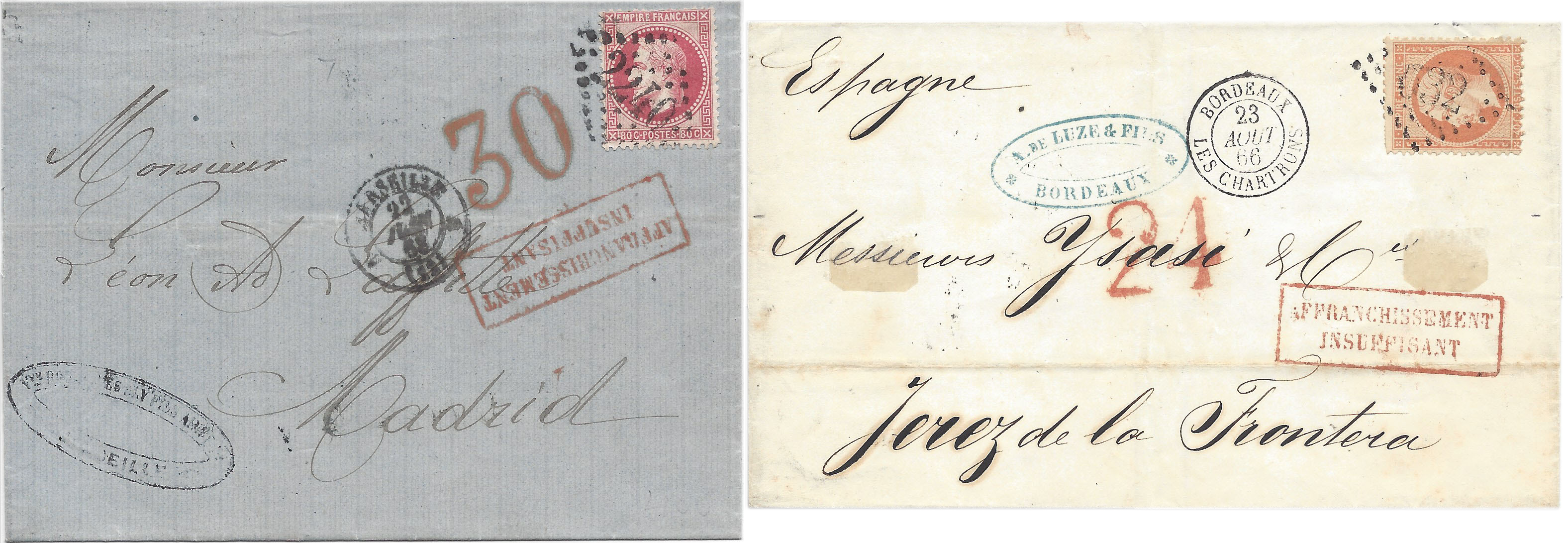
So, of course, when I noticed the big, bold numbers on these covers, they got my attention.
Both of these folded letters were mailed in France to different destinations in Spain. Neither cover was properly paid, which means these numbers represent the amount due from the recipient on delivery of the letter.
When I first encountered them, I could only provide basic, but technically correct, descriptions. The cover on the left is a triple weight letter, but it only had an 80 centime French postage stamp that would have paid for a double weight letter. The recipient in Spain had to pay 30 cuartos. The cover on the right was a double weight letter that was only paid as a simple (or single rate) letter. In that case, 24 cuartos were due at the destination.
Unfortunately, I could not explain HOW those due amounts were determined. In fact, I learned that many postal historians I knew also did not know how it was calculated. One person told me that these were the correct amounts for triple and double weight letters that were underpaid by one postage rate. But that was only because they had access to a table that showed those amounts.
Well, if you’ve been reading Postal History Sunday for a while, you won’t be surprised that I took this as a challenge and asked questions of more people and looked in more resources in hopes of finding answers.
Paying the Postage - Sort of
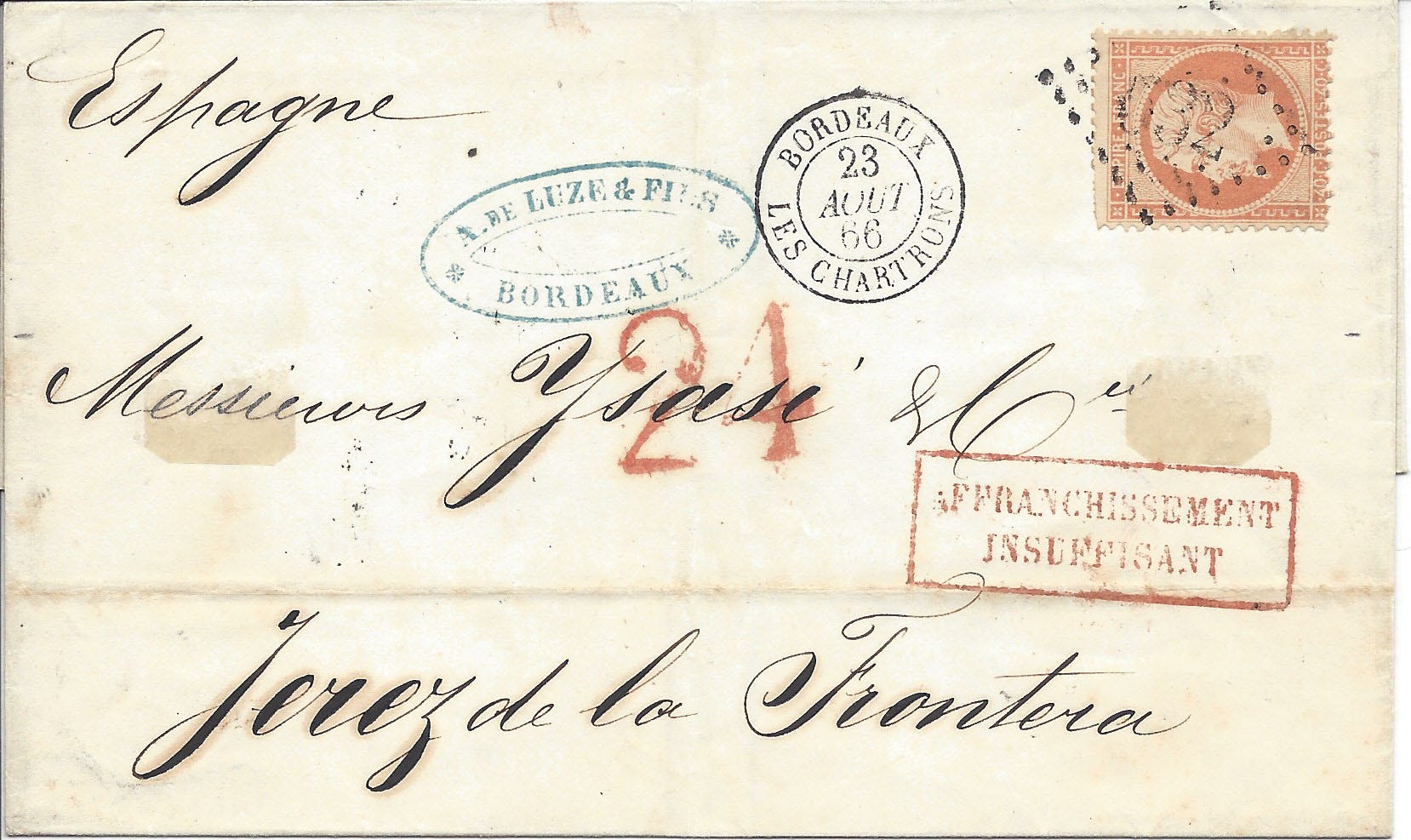
We’re going to start with the letter showing the bold “24” in red ink. This cover was mailed in August of 1866 from Bordeaux (France) to Jerez de la Frontera (near Cadiz) in Spain. The sender paid the postage (40 centimes) for a single weight letter, but it was found to be too heavy and required more postage.
At the time, nations sought to create postal conventions with other nations to determine how mail would be exchanged between them. This letter was mailed under the postal convention put into effect between Spain and France on February 1, 1860. If a person wanted to prepay the postage for a letter, it was calculated as follows:
To mail a letter from France to Spain, they would have to pay 40 centimes (French currency) for every 7.5 grams of weight.
To mail a letter from Spain to France, they would have to pay 12 cuartos (Spanish currency) for every 4 adarmes in weight (4 adarmes is about 7.2 grams).
Or, if you would like it with fewer words:
Prepaid Letters Postage:
France ----> Spain = 40 centimes per 7.5 grams
Spain -----> France = 12 cuartos per 4 adarmes (about 7.2 grams)
Do you see a possible problem? I sure do! Technically, an item that weighed 7.3 grams would be light enough for a single rate in France, but it would require a double rate in Spain.
This was clearly a recipe for potential problems.
The treaty also allowed people to send letters UNPAID. If they opted for this service, the recipient would have to pay a different rate to receive their letter. If a resident in Spain received an unpaid letter from France, they would have to pay 18 cuartos for every 4 adarmes in weight.
Unpaid Letters Postage:
France ----> Spain = 18 cuartos per 4 adarmes due on delivery
Spain ----> France = 60 centimes per 7.5 grams due on delivery
So, what happened if a person paid for a letter that they thought was light enough for a single rate letter (40 centimes), but it actually required double rate postage? Well, we get to find out because that is exactly what happened with the item shown above.
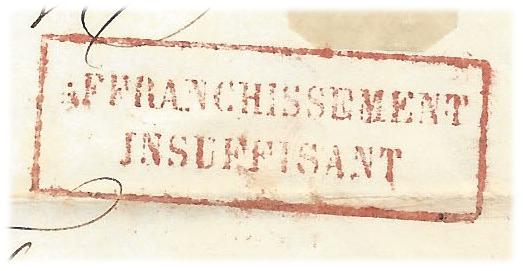
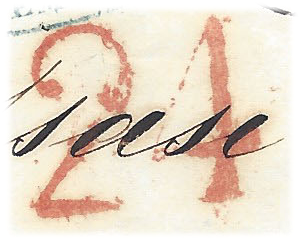
Apparently, the French post office was aware that this item weighed too much, so they put the red boxed marking on the cover which reads “Affranchissement Insuffisant“ (insufficient postage). I believe this was done on the French traveling post office on the train to Irun that calculated the amount due and put the big red “24” on the front of the cover.
So the recipient in Jerez had to pay 24 cuartos for the honor of receiving this letter, even though their correspondent thought they had paid enough. Why? It weighed more than 7.2 grams and no more than 7.5 grams.
So, how was the amount due calculated?
Many postal conventions of the time operated under the idea that a short paid item should simply be treated as wholly unpaid. But France and Spain decided that they would, at least, give some credit to the sender for making an effort to pay something for postal services.
However, they made their calculations by rating the letter using the UNPAID letter postage rate and not the PREPAID letter postage rate. After they determined that amount, they deducted the amount paid.
Remember, this was a double weight (or double rate) letter. The calculation would follow this process.
Postage for an unpaid double weight letter = 18 cuartos x 2 = 36 cuartos
Amount paid was 40 centimes in France, equivalent to 12 cuartos
36 cuartos due less 12 cuartos paid = 24 cuartos
And there you have it. Underpaid mail was penalized for failure to prepay the service properly by charging the unpaid mail rate to calculate the total fee due. However, unlike many other mail agreements of the time, this one actually gave some credit for the attempt to prepay the postage.
But, if you think about it a little harder, you will realize the recipient actually paid as MUCH as the sender would have paid if they had calculated the amount due correctly in the first place. As we will see, this would not hold true for heavier letters.
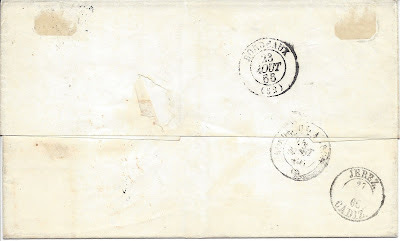
How did this cover get where it was going?
Postal markings on this cover:
Bordeaux - Les Chartrons Aug 23, 1866 (front)
Bordeaux Aug 23 (verso)
Bordeaux A Irun Aug 24 (verso)
Jerez - Cadiz Aug 27 (verso)
Les Chartrons is a district that borders on the Garonne River in Bordeaux and the first two markings likely show the progress from a branch post office in that neighborhood to the main Bordeaux office. From that point, the Bordeaux A Irun marking shows that this mail item boarded a train and the traveling post office on that train served as the exchange office for France.
From there, we have no markings to confirm the direction of the voyage through Spain, though I can make an educated guess on the most likely route. The remaining marking is from Jerez - Cadiz.
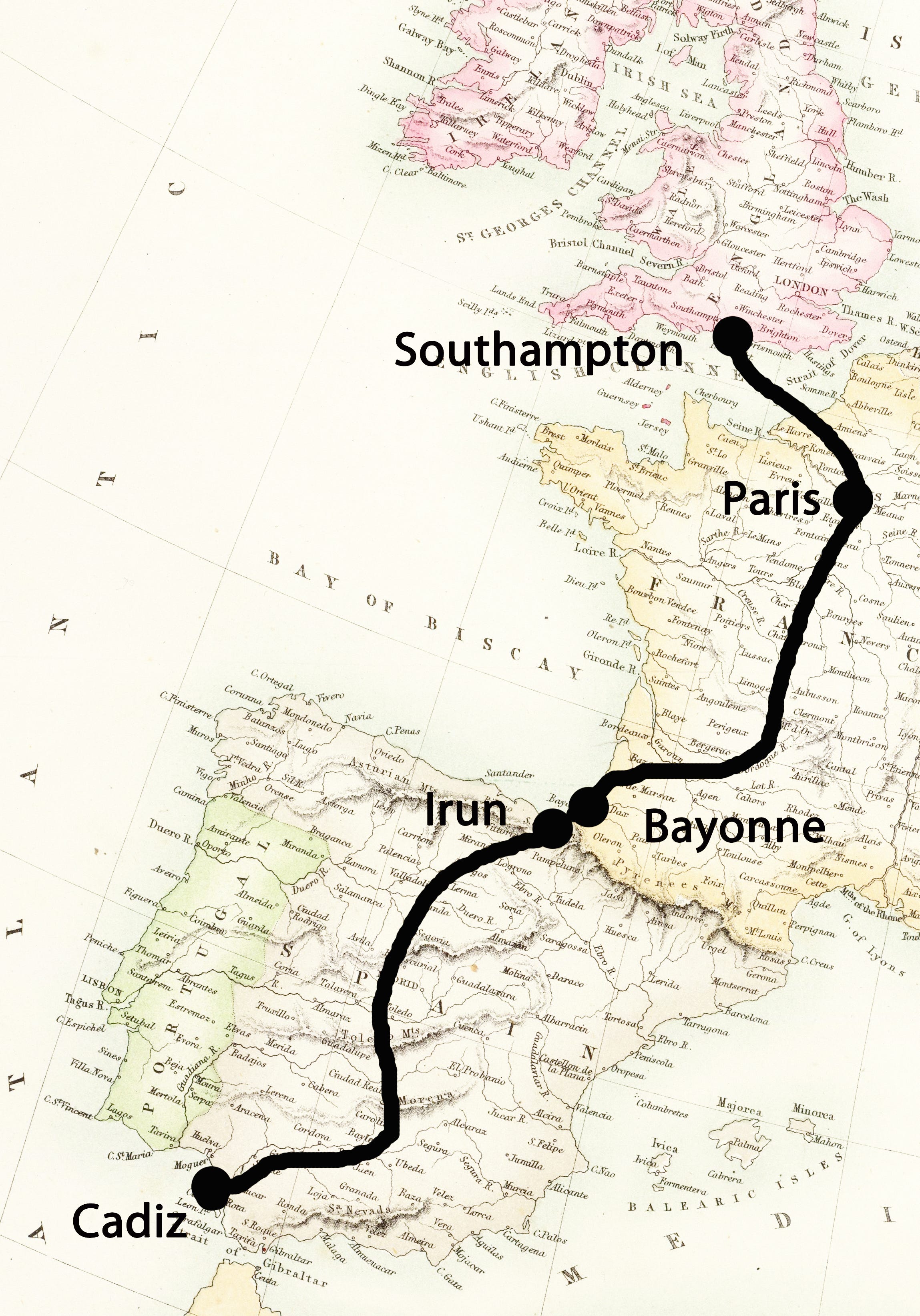
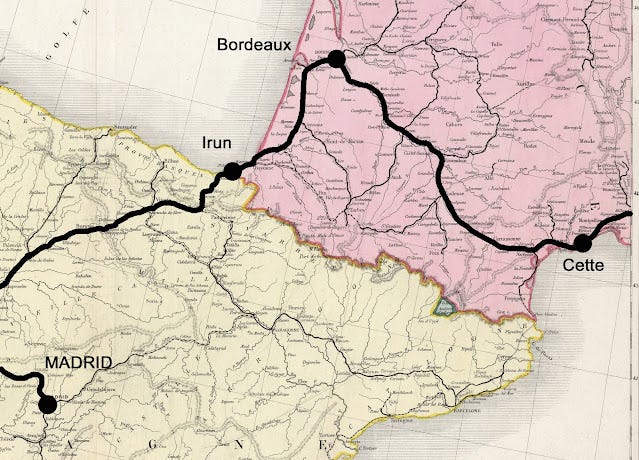
The map shown above illustrates a generalized view of the mail route via Paris for mail from England to Cadiz, Spain. Of particular note is the fact that France and Spain ran their railways on different gauge (sized) tracks. The Spanish were quite a ways behind the French and other European nations in developing rail services. Needless to say, with fewer rail options, it is a bit easier to make an educated guess regarding the route.
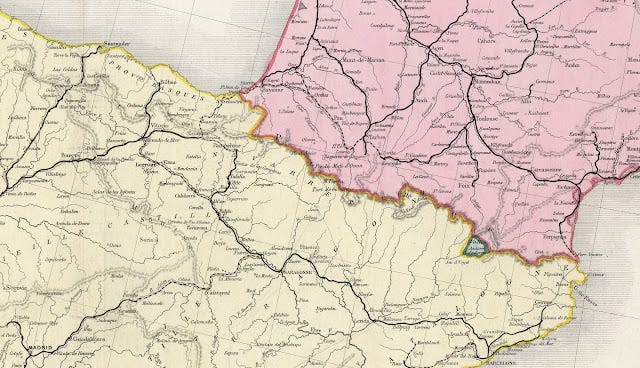
The map of the border between France and Spain from 1863 shown above clearly indicates that a rail route via Irun was planned, but necessarily completed at that time. On April 8, 1864, an agreement was reached between the two countries that trains from France to Spain would terminate in Irun (in Spain) and trains from Spain to France would terminate in Hendaye (in France). The two countries would run track to the terminus of each location on their own gauge and each train would return across the border empty, though they could load with return traffic in their own country’s territory.
Upping the Ante
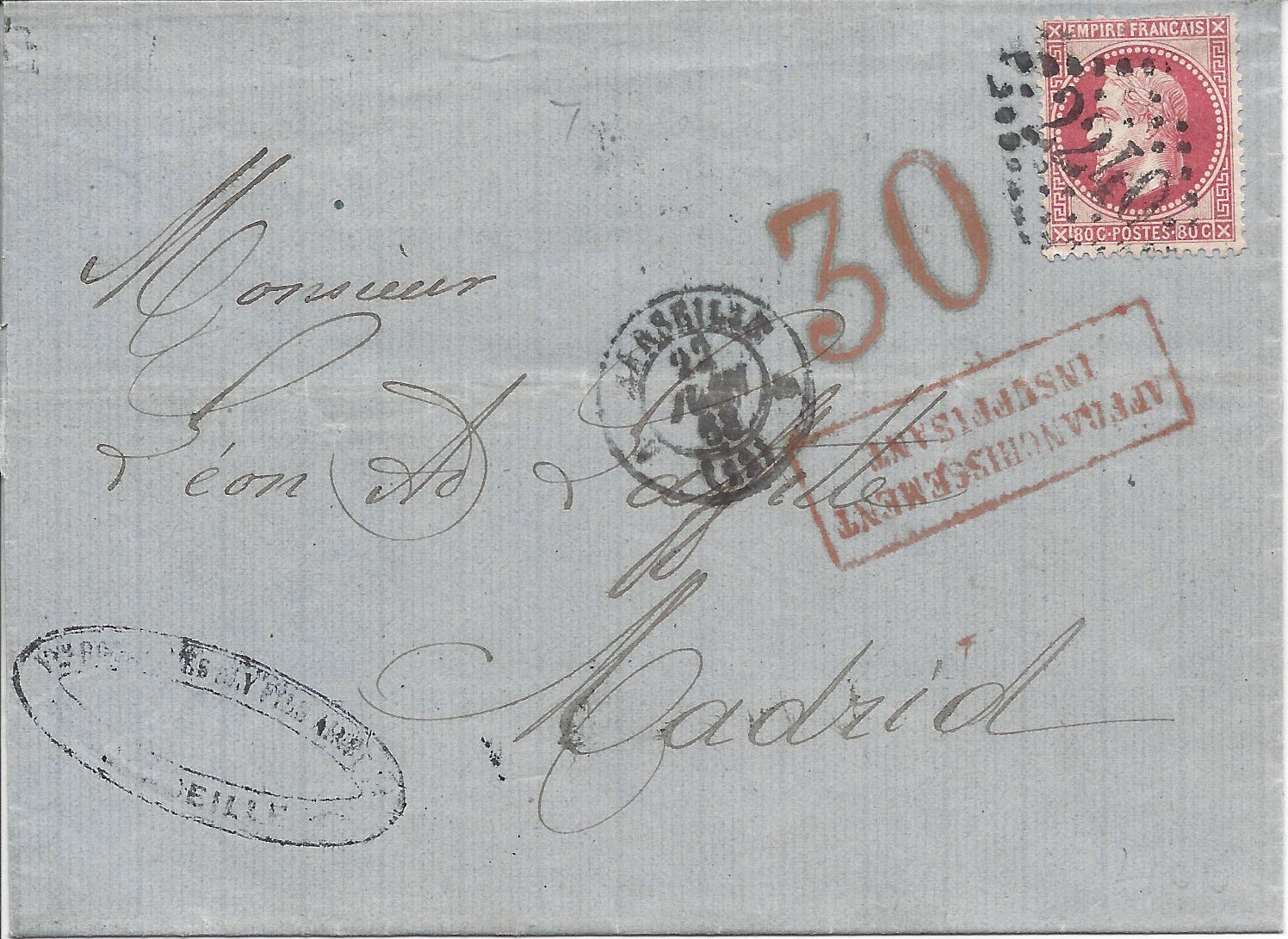
The second folded letter shows a nice, bold “30.” In this case, the letter was mailed as a double rate letter from Marseille to Madrid. Unfortunately for the recipient, the letter was found to be underpaid and they were required to pay 30 cuartos to receive this piece of mail.
Once again, the red box with “Affranchissement Insuffisant” was applied to indicate that the postage was insufficient to pay for the letter to get to the destination without further payment.
Just as a reminder, the process for short paid mail between France and Spain at the time was to determine the postage by using the higher UNPAID mail rate. Once that amount is calculated, credit is given for the amount of postage paid.
The weight of this item was greater than 8 adarmes (roughly 14.4 grams) and no more than 15 grams. This explains why the person mailing thought 80 centimes was enough. After all, that was the correct amount by the French calculation (40 centimes for every 7.5 grams). But, if it weighed 14.5 grams, the Spanish weren’t going to see it that way because they expected a rate for every 7.2 grams!
Once again, unpaid mail from France to Spain is charged 18 cuartos for every 4 adarmes in weight.
Postage for an unpaid triple weight letter = 18 cuartos x 3 = 54 cuartos
Amount paid was 80 centimes in France, equivalent to 24 cuartos
54 cuartos due less 24 cuartos paid = 30 cuartos
Getting from Here to There
The readable postal markings on this cover are as follows:
Marseille Jun 22, 1868 (front)
Cette A Bordeaux Jun 23 (verso)
Bordeaux Jun 23 (verso)
There were actually two land access points between France and Spain over which mail (other than border mail) could travel. One in the east at Le Perthus/La Junquera and the other at Irun/St Jean de Luz. Development of a rail crossing at Irun progressed much more quickly and was available by 1868, so even though this letter originated in southeastern France (Marseille), it traveled more quickly on its route than the last cover.
In viewing the map below, Marseille would be located just off the far right edge of the map.
Let’s try going the OTHER direction!
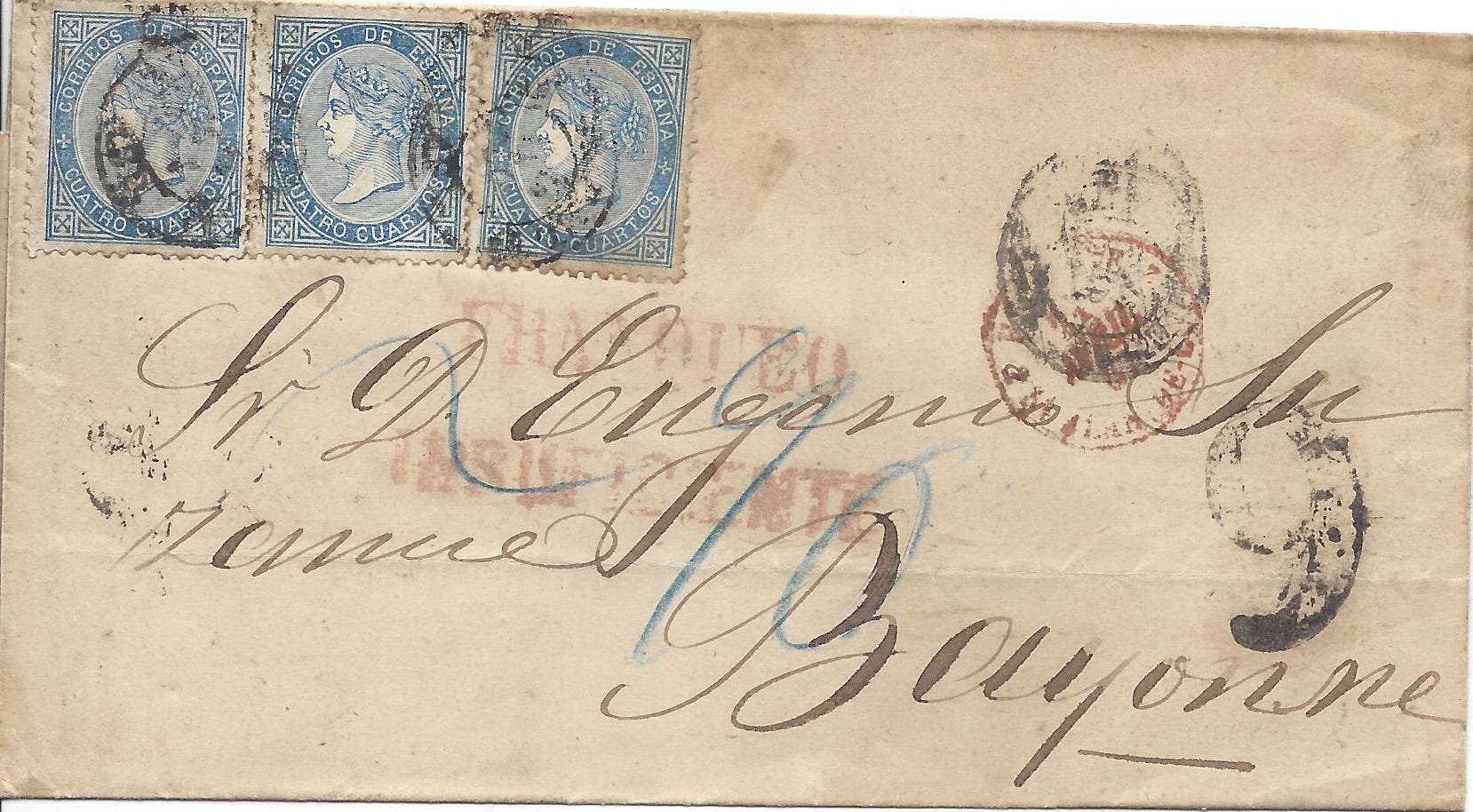
While the weight difference likely caused our first two letters to be short paid, it was still possible for a person to underestimate how much postage would be required without considering the difference between adarmes and grams. Shown above is a letter that was mailed in Santander (Spain) on April 17, 1867. The three blue postage stamps represent a total of 12 cuartos paid, which would have been correct for a simple (or single) letter weighing no more than 4 adarmes (7.2 grams).

Sadly, this letter weighed more than 4 adarmes and no more than 8 adarmes. Twelve cuartos was not enough postage and the recipient in Bayonne, France had to pay more in order to receive the letter.
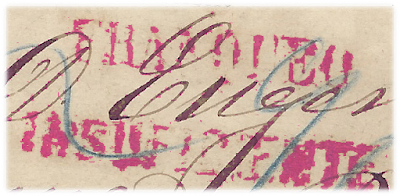
Our first clue is the marking that reads “Franqueo Insuficiente” (insufficient postage). I took the liberty of using an image editing tool to try to make the lettering stand out a bit more so everyone can see what I am talking about. I fully recognize that many postal markings are next to impossible to decipher unless you already have an idea of what it could be.
We just have to remember that postal clerks dealt with these things daily, so they knew what they looking for (most of the time). And, of course, they probably didn’t even entertain the idea that someone like me would want to try to read what a marking says 160 years later.
The other clue is the “2” that is written in blue pencil. You can see it in the image above or you can look at the original image of the cover. This tells us and other postal clerks that the letter was a “double weight” letter. It weighed more than 4 adarmes and no more than 8 adarmes. So, the sender should have paid 24 cuartos in postage, not 12.
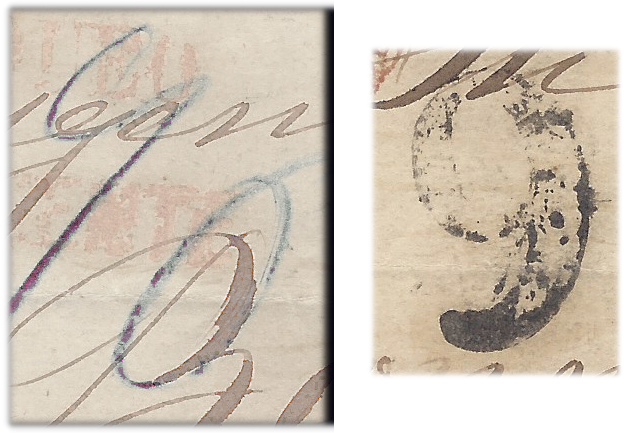
Once we figure out that not enough postage had been paid, the next question is “how much MORE postage is necessary to be paid?” The answer is actually shown above.
The payment for remaining postage was to be made in France, which means we need to think in terms of French centimes (cents) or decimes (dimes). Getting right to the chase, the “9” in black ink represents 9 French decimes and the blue “90” is 90 French centimes. Both are exactly the same amount.
So, the recipient owed 90 centimes (9 decimes) at the point of delivery. And the calculation of the amount comes from a similar process as our previous letters.
Unpaid rate of mail from Spain to France was 60 centimes per 7.5 grams
Postage for an unpaid doulbe weight letter = 60 centimes x 2 = 120 centimes
Amount paid 12 cuartos in Spain, equivalent to 40 centimes
120 centimes - 40 centimes = 80 centimes
Um…. Wait a minute! That’s not the same as 90 centimes.
It’s at this point you are probably wondering if I neglected to do all of my homework. But, never fear, I do have an answer!
We need TWO more facts that will finish this for us.
Incoming mail to France from Spain was charged an extra 5 centimes
Postage due was rounded up to the nearest decime.
120 centimes - 40 centimes + 5 centimes = 85 centimes
rounded up to the nearest full decime = 90 centimes
And there you have it! I know I feel a whole lot better now. How about you?
The 5 centime drayage right (droit de factage)
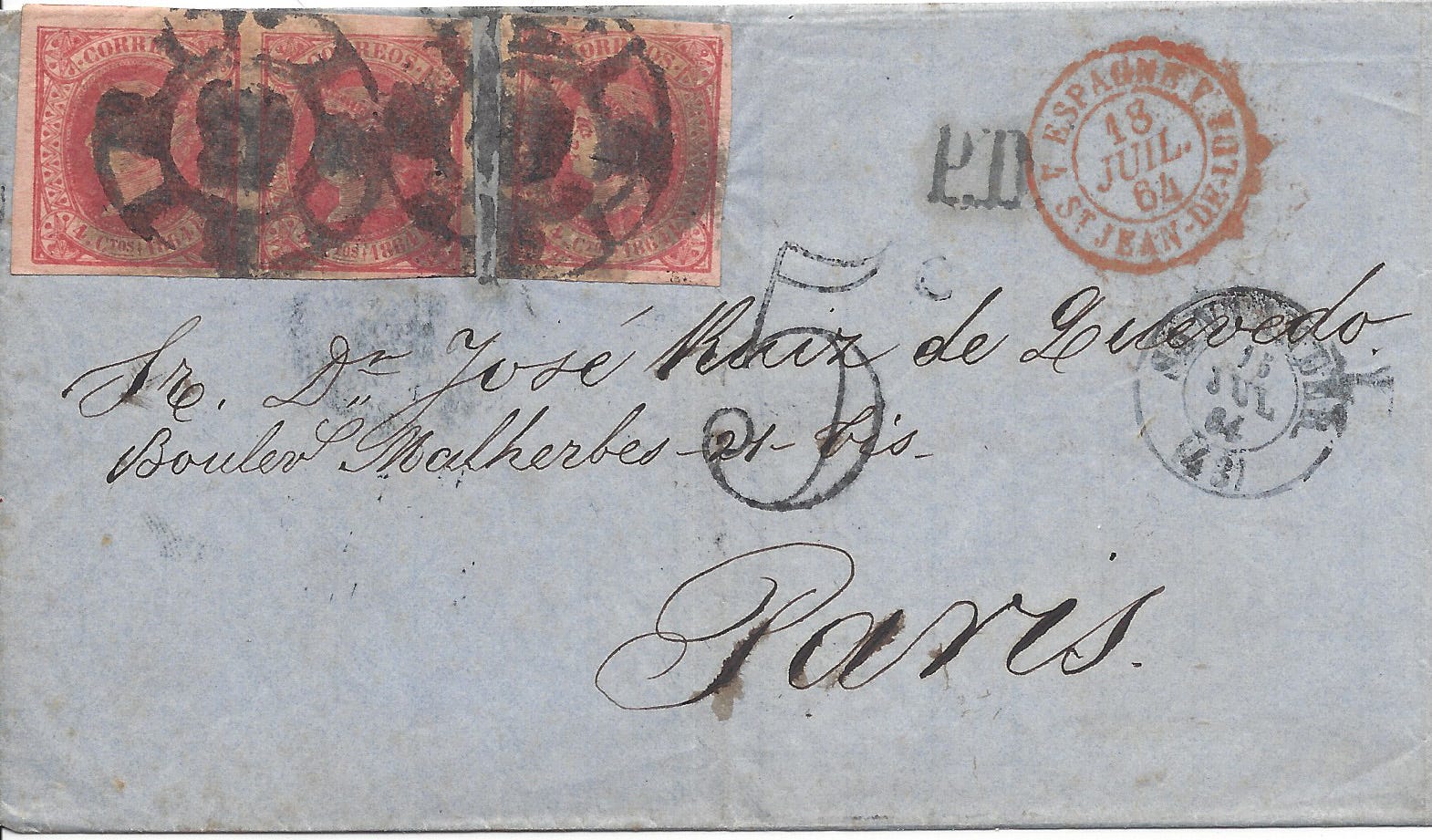
To make sure the story is filled out right and proper, here is a letter that was correctly prepaid 12 cuartos for a simple letter that weighed no more than 4 adarmes. This piece of mail also originated in Santander and was destined for Paris.
A black marking that shows the letters “P.D.” tells us that the postage was properly paid - EXCEPT, the recipient still owed 5 centimes simply because the letter came from Spain.
This 5 centime “droit de factage” (drayage right) was a bit of “tit for tat.” The Spanish collected a delivery charge of 1 cuarto for all incoming mail from other countries (called “derecho de cartero”). This practice continued despite the postal agreement with France that went into effect on February 2, 1860 that indicated payment of postage should cover all costs to the destination. As a result, the French added their 5 centime fee for incoming letters from Spain (but not other countries). This was a flat fee and was always 5 centimes, regardless of the weight of the letter.
In case you go back to look at the covers mailed from France to Spain for evidence of the 1 cuarto delivery charge, you won’t find it. That fee was not indicated by a postal marking on the cover.
Since there was no way the sender of a letter could successfully pay the delivery fee in Spain or the drayage right in France, there was no way to apply a postage stamp to cover that cost.
Spain ended their 1 cuarto delivery charge on July 2, 1869 and France followed by removing the droit de factage on July 15.
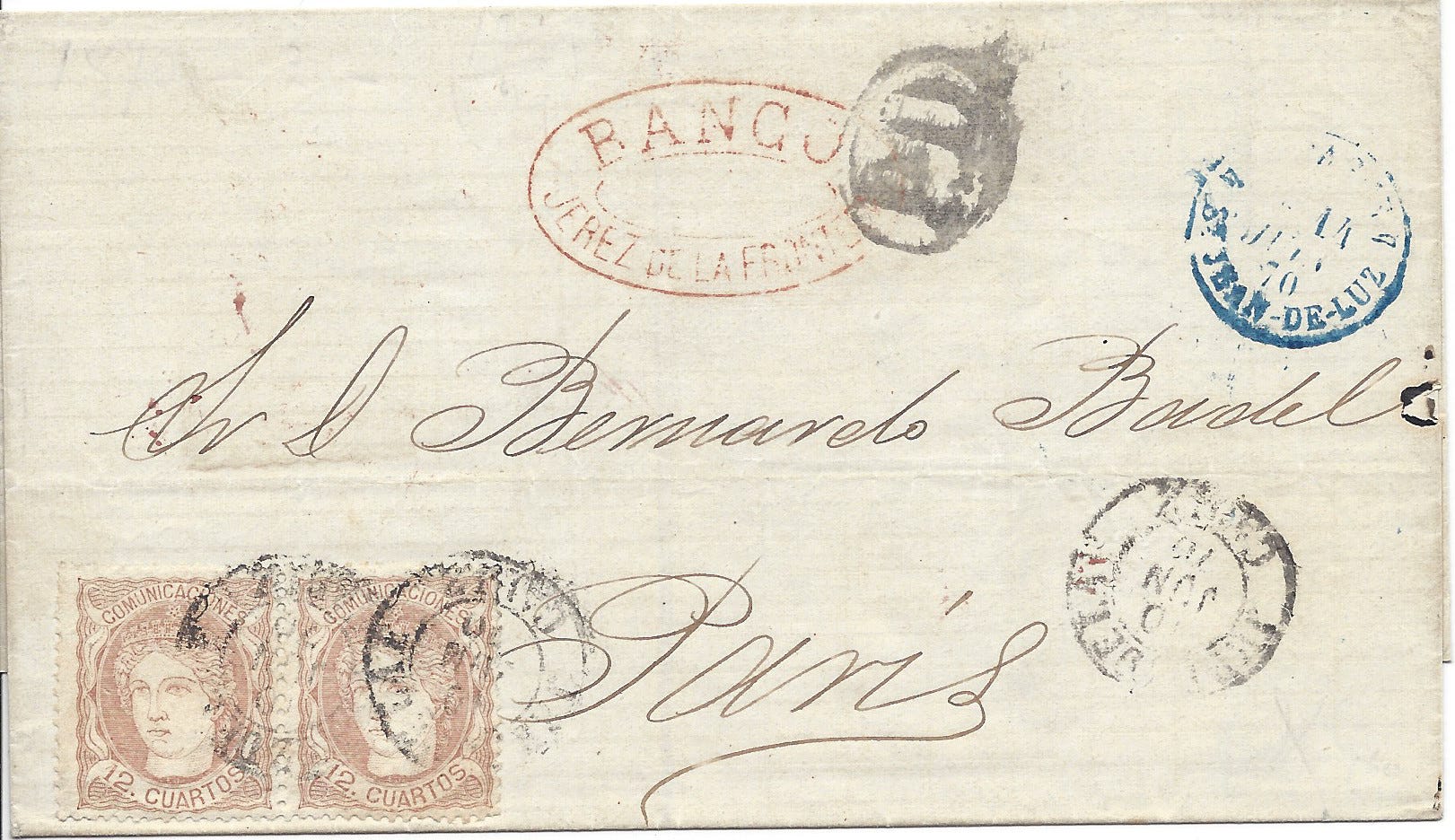
And here is an example of a double weight letter from Spain to France that was mailed after the droit de factage was removed. There are two 12 cuarto stamps that properly pay for this double weight letter that weighed more than 4 adarmes and no more than 8 adarmes. There is no 5 centime marking to indicate drayage.
And now, even I can say I might have had my fill of numbers for the day. But I do have an urge to laugh while thunder rumbles in the background and lightning brightens the sky.
I hope you enjoyed today’s Postal History Sunday! Have a great remainder of your day and a fine week to come.
Postal History Sunday is featured weekly on this Substack publication. If you take this link, you can view every edition of Postal History Sunday, starting with the most recent publication. If you think you might enjoy my writing on other topics, I can also be found at the Genuine Faux Farm substack.
I love your passion for postage. My only postage interests were in the love letters my paternal grandparents wrote to other in rural Louisiana in the early 20th century. While they were engaged they were only about 30-35 miles apart as my grandfather was working on a farm. He had little chance to return during the season as transportation was by horse or mule drawn wagon.
I don't think there are any questions concerning the postage, but the contents have always puzzled my sister and me. Both of them were white but they frequently ended with a racial slur as an endearment. I've searched for years to try and find out if that was common among poor whites in the south.
The other thing that interested me was that your team of choice is the Cincinnati Reds. Living in Kentucky my father-in-law was too. We both watched them on TV and once, after my wife and I moved to Indianapolis we met them in St. Louis for a weekend trio of games. I had some fondness for St. Louis because my parents were married there and Dad was a St. Louis fan.
At that particular series we stayed in the same hotel as the Reds. Johnny Bench had been my favorite player up until Saturday morning as the team was leaving to board the busses for the stadium. They had to pass through two dozen kids wanting autographs. Some of the others stopped but Bench literally kept his eyes toward the ceiling and walked by them. I never felt the same about him.
The last game was on Sunday night so we spent another night in the hotel and ate breakfast in the hotel. The Phillies had arrived the previous night and were having breakfast, too. Our table was right next to four Philly players but only one I recognized---Tim McCarver who had previously been with the Cardinals. He, too, was a favorite player. And, just as always McCarver's jokes to his teammates had them laughing and my father-in-law and I at the next table were laughing, too.
I haven't been following you long, but what I most admire is your passion for a not so popular hobby. But then I knew a guy who liked to collect the pin insulators for electric lines from decades ago. I thought he was crazy until I discovered some were worth as much as $1000 depending on size and coloring.
Thanks for the memories.