
Flagship Lancaster
Postal History Sunday #289

Topic selection is an ever evolving process for me with Postal History Sunday. Obviously, the biggest contributing factor has to be whether I feel ready and motivated to write about a given subject area.
Truthfully, there are many weeks where I feel ambivalent about it and there are even times when I can barely find it in me to write at all. Ideally, I get a start on a few articles and they wait in the wings for those moments when I can implement my content plan where I attempt to provide diversity to the entries you receive throughout the year.
Last week was a very postal history specific article. There wasn’t much social history or other material to support the writing. Those articles are often good learning/teaching pieces and really enjoy writing them. Articles like today’s Flagship Lancaster, are shorter on the pure postal history content like rates, routes, postal markings, etc. And, because they take more time in research, I have to find ways to spread them out.
I think I finally found the resources I wanted, so we’re going to give this one a go! Tie your troubles to a cement block and throw them in the ocean. Get a favorite beverage and a snack. Put on the fuzzy slippers and sink into a comfy reading chair.
It’s time for Postal History Sunday!
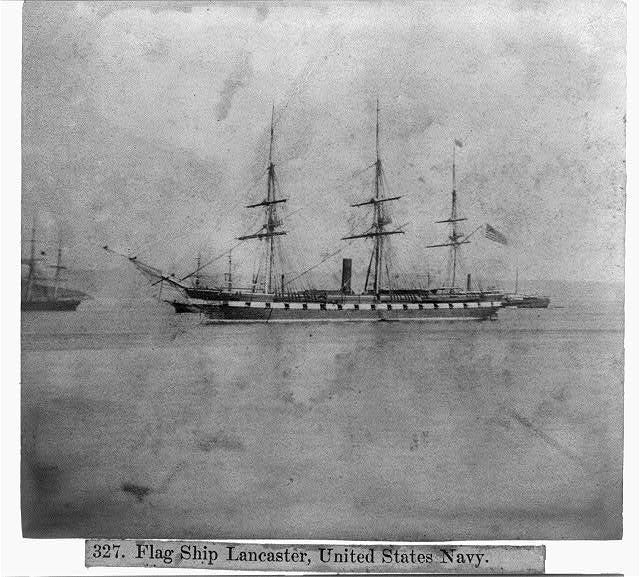
USS Lancaster
This week, we’re going to start “backwards.” Instead of showing you a piece of postal history and then working to other things, I’m going to start with a US Navy ship whose keel was laid (construction began) in 1857.
The USS Lancaster* was first launched from the Philadelphia Navy Yard in October of 1858. It was not commissioned until May of 1859 when it departed to serve as the flagship for the US Navy’s Pacific Squadron. While in that capacity, Lancaster ran up and down the coasts from South America to North America, protecting US mail steamships and commercial interests until 1866.
Lancaster’s second commission was as flagship in the South Atlantic from 1869 to 1875, when the ship was laid up for repair. It would not be until 1881 that the ship would be recommissioned to serve as flagship for the European Squadron. Duties during that time included patrolling northern European waters, the Mediterranean and the coast of Africa.
The Lancaster would also serve as flagship of the Asiatic Squadron starting in 1891 and as part-time flagship again in the South Atlantic Squadron from 1895-97. After that point, her flagship days were over. She would serve as a station ship (often an older ship that stayed at a specific location or port to provide support for operations) and a training and transport ship during the war.
After the war, Lancaster served as a receiving ship (a vessel moored in a Navy yard to house sailors in transition to or from assignment) until 1912. In it’s last stage of service, Lancaster served as a quarantine ship, including the New York Quarantine facility until is was broken up in 1933.
Today’s Postal History Sunday is interested in the period of time from 1885 to 1886 that USS Lancaster sailed the coast of Africa and crossed back and forth the Atlantic to Brazil, once again as flagship.
*for those with interest, Bob Plord has models of several ships, including the Lancaster. Plord routinely gives the basic statistics of the ships on web pages showing those models.
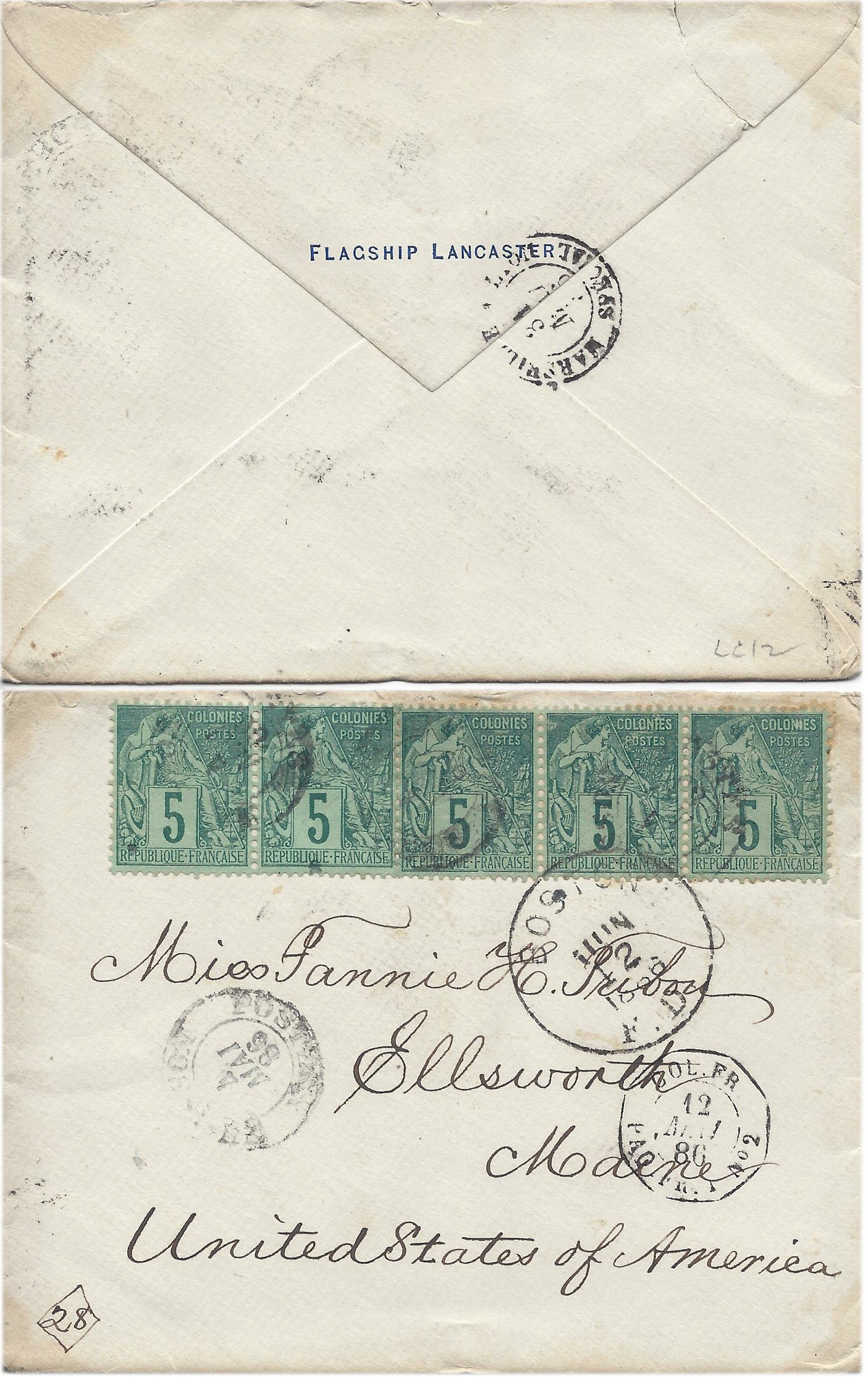
Nossi Be to the United States
And now we actually get to see one of two covers that are featured in today’s article. This first item was sent from someone using Flagship Lancaster stationery to Miss Fannie H. Pribon (sp?) in Ellsworth, Maine (US).
The letter has five 5-centime postage stamps that were issued for the French Colonies, which properly prepaid the 25 centime rate for a simple letter weighing no more than 15 grams. This was the rate set by the Universal Postal Union. The French Colonies were included in that agreement beginning July 1, 1876, six months after France was admitted (Jan 1, 1876).
This letter was posted in Nossi Be on May 4, 1886, which is witnessed by the marking at the left of the envelope that reads “Postes Nossi Be.” It was then carried by a French mail steamship that departed from Nossi Be on May 12. A month later, the envelope arrived in Boston, likely arriving in Maine the next day - but there is no marking to confirm the arrival in Ellsworth.
I will take a guess that this was part of a regular correspondence between two people. The diamond shape with the number “28” at the bottom left is probably a notation by the recipient to keep the letters in order of receipt.
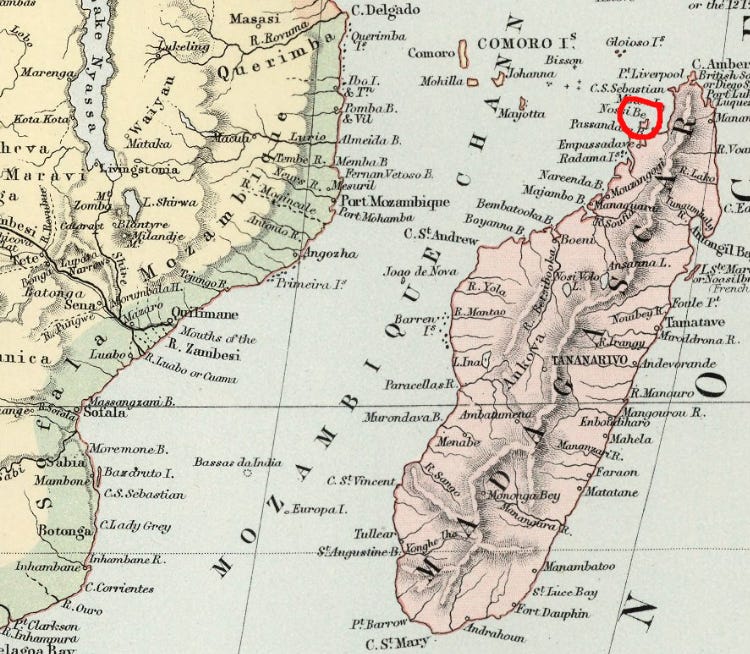
Nossi Be (now Nosy be) is a large island just off the northwest coast of Madagascar. The French colonized Nossi Be (Big Island in the Malagasy language) in 1840 and remained under French control until Madagascar gained independence in 1960. Hell-ville (named after Admiral de Hell) was the principle French outpost on the island and was the location of the main port on the island.
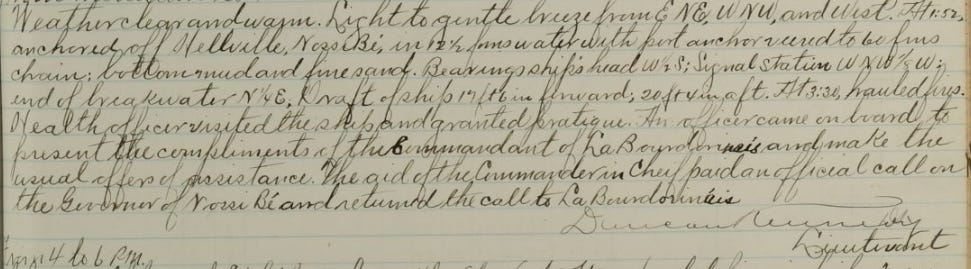
The logbooks for the Lancaster’s voyages during this time period have been digitized, making it relatively easy to ascertain and verify where the ship was and when. The entry for April 23, 1886, includes the information for the time Lancaster anchored at Hellville.
“Weather clear and warm. Light to gentle breeze from ENE, WNW and est. At 1:52, anchored off Hellville, NossiBi in 12 1/2 fms … At 3:30… health officer visited the ship and granted pratique…”
Granting pratique occurs once it has been ascertained that there is no concern for infectious disease. At that point the ship may land personnel and cargo.
The logs are typically full of weather reports and sailing data. However, there are also mentions of other ships coming into port (a French and US ship on the 24th). Dignitaries from Nossi Be and other ships came on board and were honored and officers left the ship to attend other functions as well. One sailor came to the end of his enlistment at this port and was discharged and a few punishments for fighting and other unwanted behaviors were meted out.
The ship received 1400 gallons of water on the 27th before departing Nossi Be on the 28th. The next destination would be St. Mary’s on the east coast of Madagascar.
There are no contents in this letter, so we can’t really be sure when it was written. But, at some point from the 23rd to the 27th of April, this letter was taken ashore. It was processed at the French post office there on the 4th of May and sailed on the French mail steamer on the 12th.
Cape Verde Peninsula
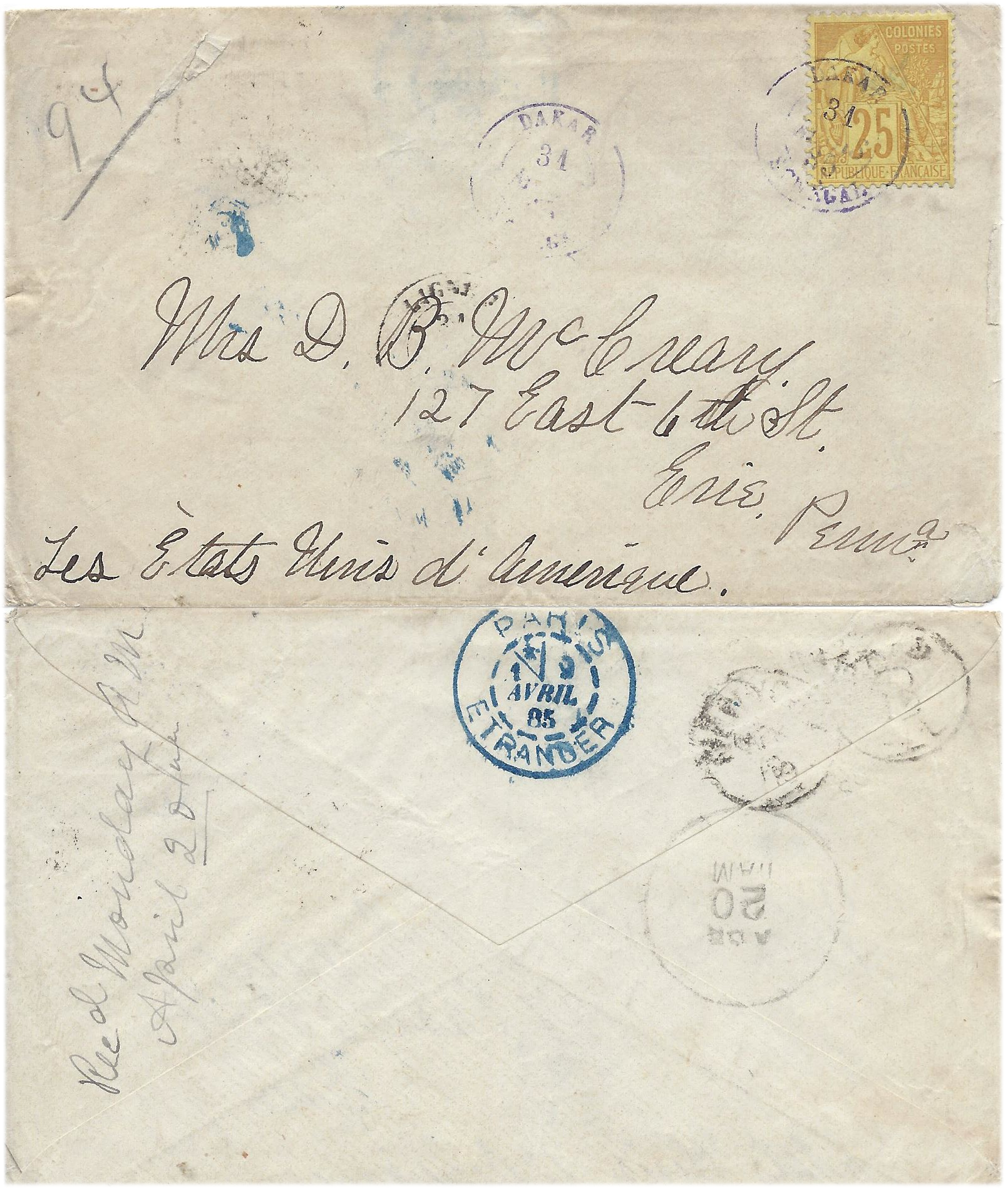
The second cover for today was also mailed by a person who was sailing on the Lancaster while it was cruising the coast of Africa. This time, the ship was on the west side of the continent, just off the coast of Senegal at the port of Dakar on Cape Verde.
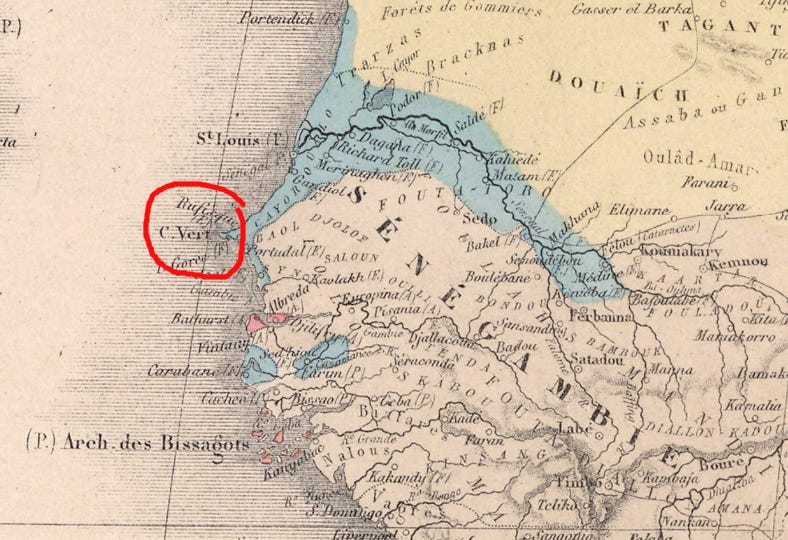
The map above can give you some idea as to the location of Dakar as well as the status of colonization in the area. The blue area indicates French control. The yellow shows Portuguese areas of influence and and the reddish color shows British administration.
The Portuguese arrived first when Dinas Dias arrived in Dakar in 1444. The Dutch West India Company purchased the island of Gorée in 1627. The French and British became more involved in the area in the 1700s.
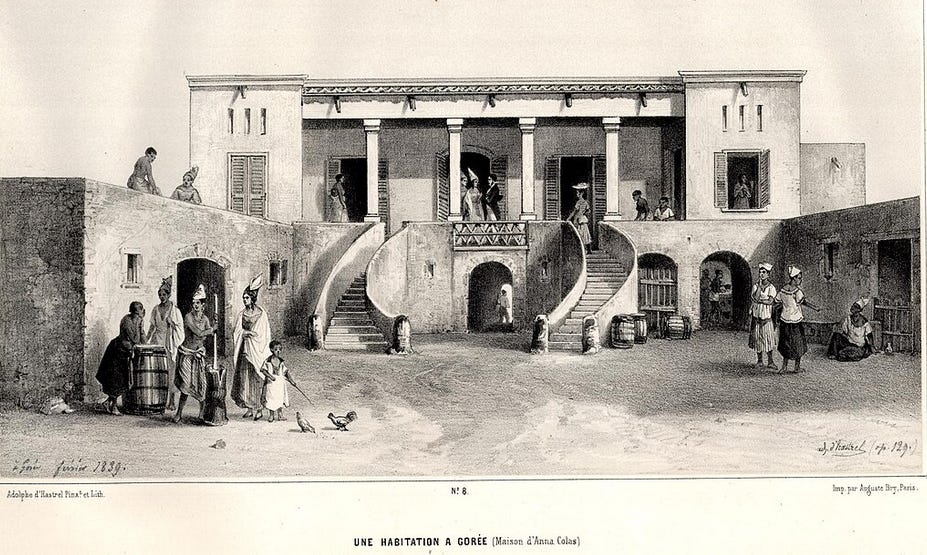
Gorée has been promoted as a major slave trading hub from the 1500s until the Second French Republic ended slavery in French territory in 1848. The House of Slaves (shown below) is a museum that memorializes the millions who were enslaved and taken on ships from Africa. The Senegalese government took advantage of increased interest regarding African heritage and made claims that as many as 20 million slaves were shipped through this island. However, that status has been strongly disputed, and the importance of this particular location has been grossly overstated.
Regardless of the dispute with respect to the details of this particular site’s significance - it still serves as a good reminder that the slave trade was a monstrous activity that impacts all of us to the present day. If you want to learn more, I might suggest this article from Oxford Research Encyclopedias as a start.

At the point this letter was sent, the slave trade was no longer tolerated, but the French did operate Senegal as a colony (until 1960). So, once again, we have a simple letter that required 25 centimes in postage. This time, a single 25 centime stamp was applied to pay the bill.
The letter was postmarked in Dakar on March 31 and a second, partial postmark shows that it was placed on a French mail ship on the same day. It was processed in Paris on April 9 and finally arrived at its destination in Erie, Pennsylvania on April 20.
And, this time, we have some contents!
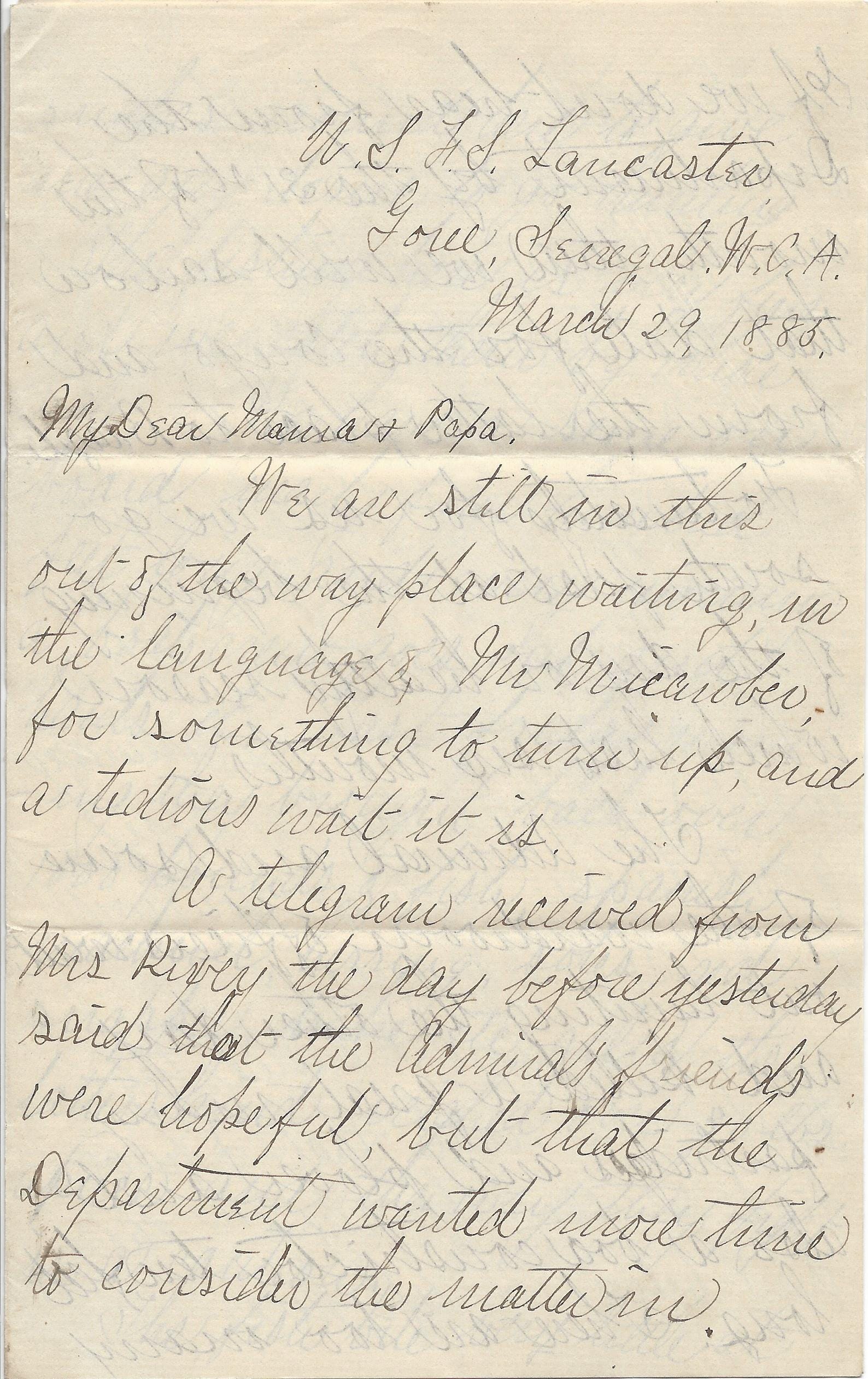
The letter starts on March 29 and is addressed to the parents of a (probably) young man who identifies that he was in “steerage,” which would have referenced the lowest ranking members of the crew. This probably explains why I cannot find help with their name at the “Our Family Tree” site. Even so, this person, whose signature if very hard to decipher, sounded fairly aware of the goings on of the ship.
I suspect if you spent a good deal of time in close quarters with 300 or so of your closest “friends” it was going to be hard to keep secrets. And, equally hard to avoid the rumor mill getting out of hand.
The letter starts with a bit of frustration. The Lancaster had been sitting in part at Dakar for quite some time.
“We are still in this out of the way place waiting … for something to turn up, and a tedious wait it is.
A telegram received from Mrs. Rixey the day before yesterday said that the Admiral’s friends were hopeful, but that the Department wanted more time to consider the matter.
If we don’t hear from the Department by the 31st of this month, then we will sail on that date for the Congo and from the latter place to Brazil.”
from the letter by McCreary to his parents
According the log books, the Lancaster did set sail for the Congo late afternoon on the 1st of April, which may or may not indicate that the requested information had arrived. The ship had been sitting in the harbor since its arrival on the evening of March 15.
The first couple days in the log seem to suggest that normal procedures were being followed. Salutes to the French warship in the port, a visit by the French admiral, Court Marshall proceedings, and standard maintenance dominate the first full day at port in the ship’s logs. On March 26, they moved from Goree to Dakar to receive 156 tons of coal. Based on the regular pattern, they were probably ready to go, but were apparently awaiting instructions.
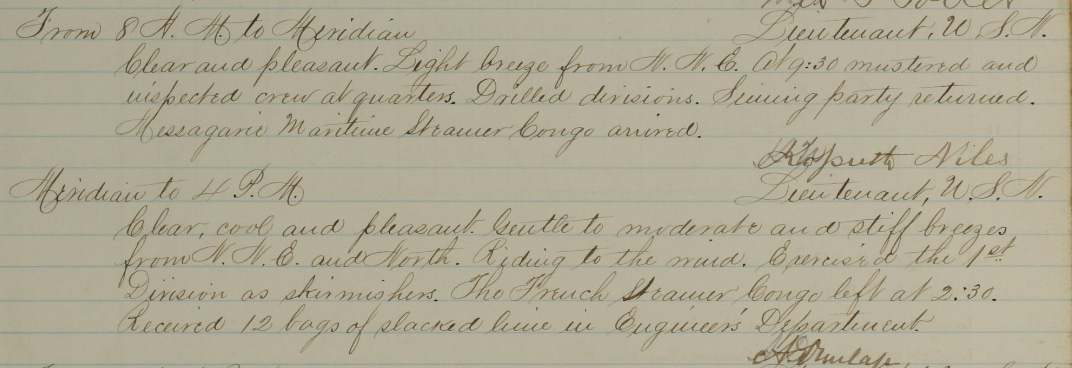
The ship log entry shows that the “Messagerie Maritime Steamer Congo arrived” in the morning and left that afternoon. This letter would have left on that steamship. It is also probable that the Admiral either received a message with additional instructions or he decided to follow the back-up plan and depart the next day.
Unfortunately, ship logs are typically rather dull, but they provide certain factual information that is worthwhile. Happily, this letter serves as some color commentary that goes beyond the ship logs.
“Last night Knepper and myself went into the wardroom for dinner (they invite two of the steerage in every Saturday night) and we had a very good dinner. Enclosed you will find the bill of fare.
Last night I tasted the first fresh meat that I have had since February 8th, the day before we left Nice.”
This explains why this sailor seemed so willing to share insight with his family about the ship’s current situation. In fact, I find this tradition to be a brilliant method to combat rumors on a ship.
This sailor shared some additional tidbits that are very interesting to me (and maybe to you).
“The Admiral and some of the wardroom officers went out hunting the other day and killed a great many partridges and plover and also a boa constrictor ten feet long. There are too many snakes around here to give me any desire to go hunting. The fishing here is very fine and we catch them by the wholesale. We have a seine on board nearly four hundred feet long and every morning a boats crew goes out and hauls it. Last Friday morning they brought back over 1000 pounds of fish, Spanish mackerel, herring, soles, red snapper, brake, etc. all of the latter kind weighed over 30 lbs apiece and the way they fight is a caution.”
Of course, rank hath its privileges and the officers were able to get out a bit more than the seamen in steerage. But, the letter makes it seem possible that he could potentially go hunting with a group if he wanted to.
I do find it interesting to get a peek into the processes of feeding crew. The writing mentions that he finds “salt horse” agrees with him “just fine” and that he is eating well. He points out that they have to make a decision between “salt” and “fresh” meat because they cannot store both on the ship at the same time.
“The Admiral and staff went up into the country on the rail road and as the train was returning the engine and some of the cars went over an embankment, but fortunately nobody was hurt. The car the Admiral was in was the last car on the train and fortunately remained on the track.”
Now there’s an interesting tidbit a seaman can share with his mates after dinner with the officers!

The Dakar - Saint Louis railroad connected two of the primary French settlements on the West African coast in Senegal. Several newspapers in June of 1885 announced the completion of this railway, which tells us the rail line was not very old and was probably not complete the entire distance to Saint Louis from Dakar at the time this accident happened.
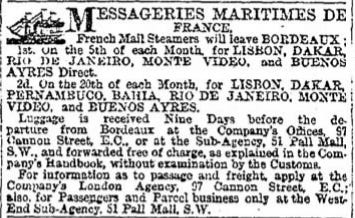
Both the letter writer and the log book were very much in tune with the arrivals and the departures of French mail ships and their schedules. As we can see from this June 1885 newspaper clipping, ships departed from Bordeaux on the 5th and 20th of each month. The route was through Lisbon and Dakar on its way to South America.
The log book has a notation that the Messagerie Maritime Steamer (MMS) Niger departed the port at Dakar on March 28. Because our letter writer does not mention it, we can ascertain that this was an outbound ship. And, we can probably deduce that it was normal for these mail ships to traverse from Bordeaux to Dakar in about eight days.
Both the letter writer and the ship’s log mention the arrival and departure of the MMS Congo on the 31st of March. In fact, the sailor mentions that his parents will likely receive another letter he wrote that had probably been waiting in the post office for this steam ship.
If we assume that the letter would take 8 days to Bordeaux, this lines up nicely with the blue Paris postal marking on the back of the envelope. It would take another 11 days before the letter reached this sailor’s parents in Erie.
Bonus Material
A while back I was asked why I italicize ship names and I thought it was an interesting enough question that I should answer it in today’s Postal History Sunday.
If you are a writing style manual sort of person, both the Chicago Manual (CMoS) and the Modern Language (MLA) styles indicate that the name should be italicized. The prefix, such as USS (US Steamship) or HMS (Her Majesty’s Steamship) are not italicized if you intend to use them.
So, I am trying to write with some consistency from within established writing styles.
For those of you who are not a “joiner” or a bit of an “iconoclast,” let me give you a practical reason for doing so.
“Africa sailed to Europe on Wednesday with the US Mail.”
That could be a perfectly valid statement in Postal History Sunday. There were (and probably still are) ships named Africa, and Europe and New York and Amsterdam. The italics provide you with a clue that I am not talking about the geographic names.
And now you know - even if you never felt you needed to know this at any point prior to this in your life.
You’re welcome!
Have a fine day and an excellent week to come.
Postal History Sunday is featured weekly on this Substack publication. If you take this link, you can view every edition of Postal History Sunday, starting with the most recent publication. If you think you might enjoy my writing on other topics, I can also be found at the Genuine Faux Farm substack.
As always another great weekly article! I have the same question as Gus, where did you find the logbook on-line? I sent you a picture of my USS Lancaster cover and letter.
In times past I was interested in the stamps and postal history of St Helena. Over the years I found 5 covers related to the Lancaster, including two from Wilt McCleary and two from Pribou (not sure I remember the correct spelling). And, I believe, I still have some write ups around, if I can find them. Happy to provide them if useful as I believe there is some information that would supplement your wonderful presentation.